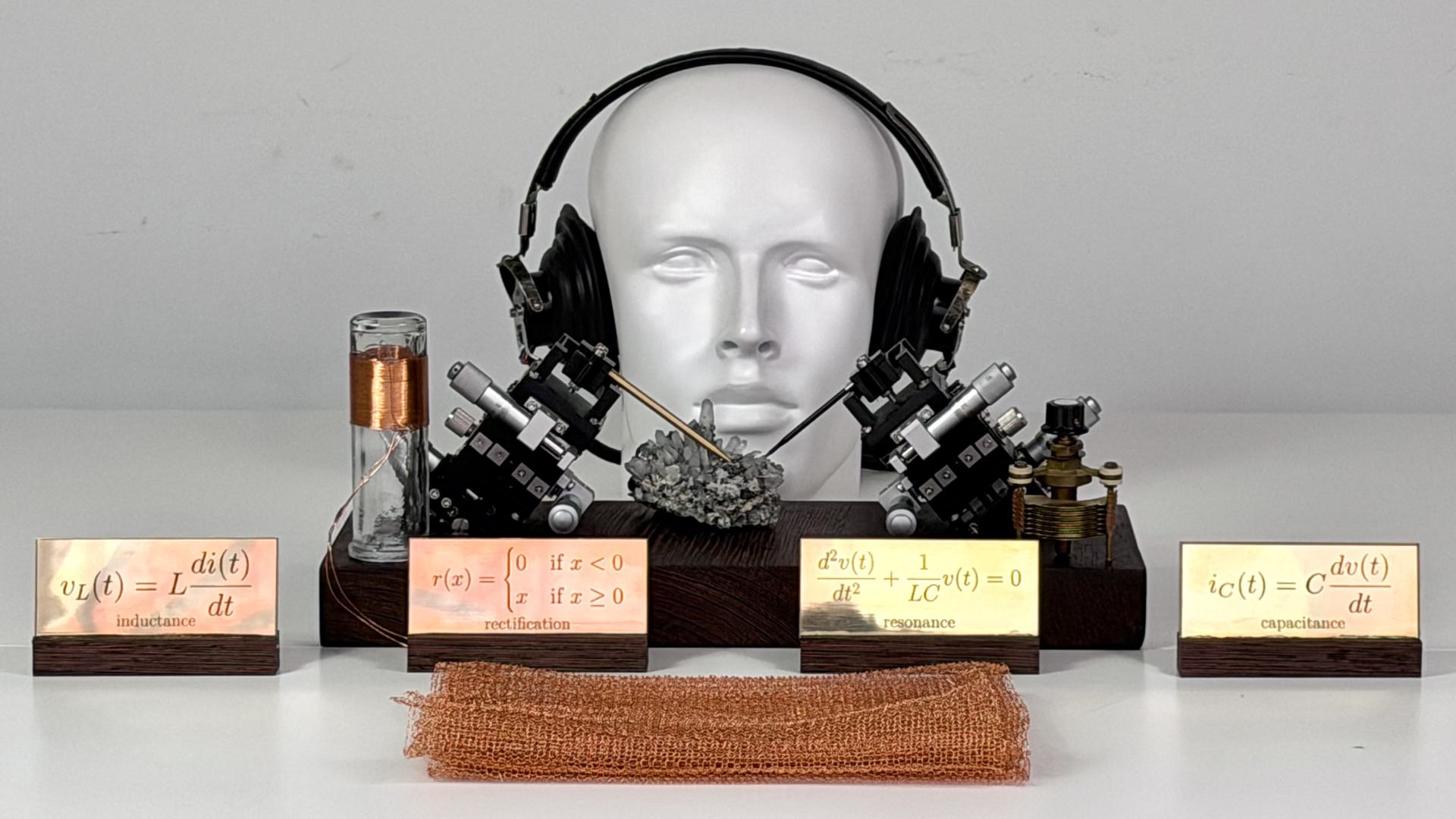
Mathematical radio
Mathematical Radio is a crystal receiver: a galena crystal, a steel whisker, a hand-wound coil, and kinematic mounts lifted from precision-engineering work down the road. It takes no power. The signal itself moves the diaphragm, which is either a banality of physics or the strangest thing in the room, depending on how long you stand there. Loe Feijs was given a boys' radio book at ten, with instructions for building a detector much like this one; Ralf Jacobs grew up on the early internet instead. The work is the two of them re-reading that book, one remembering it and one meeting it for the first time.
What the receiver picks up is a closed loop of its own making — a vintage tube transmitter carrying a script of bell tones, spoken equations for resonance and rectification, and John Donne's Meditation XVII. Nothing here is invented. Every part of it is proven, published physics, available to anyone with a length of wire and some patience. That is the point. The dreaminess of radio survives full explanation. You can account for every step from antenna to ear and still be left with a voice arriving from somewhere else, which is what the word carrier was always quietly admitting.