This project is now archived and was part of DDW24
This project is part of
Embassy of Circular & Biobased Building
→
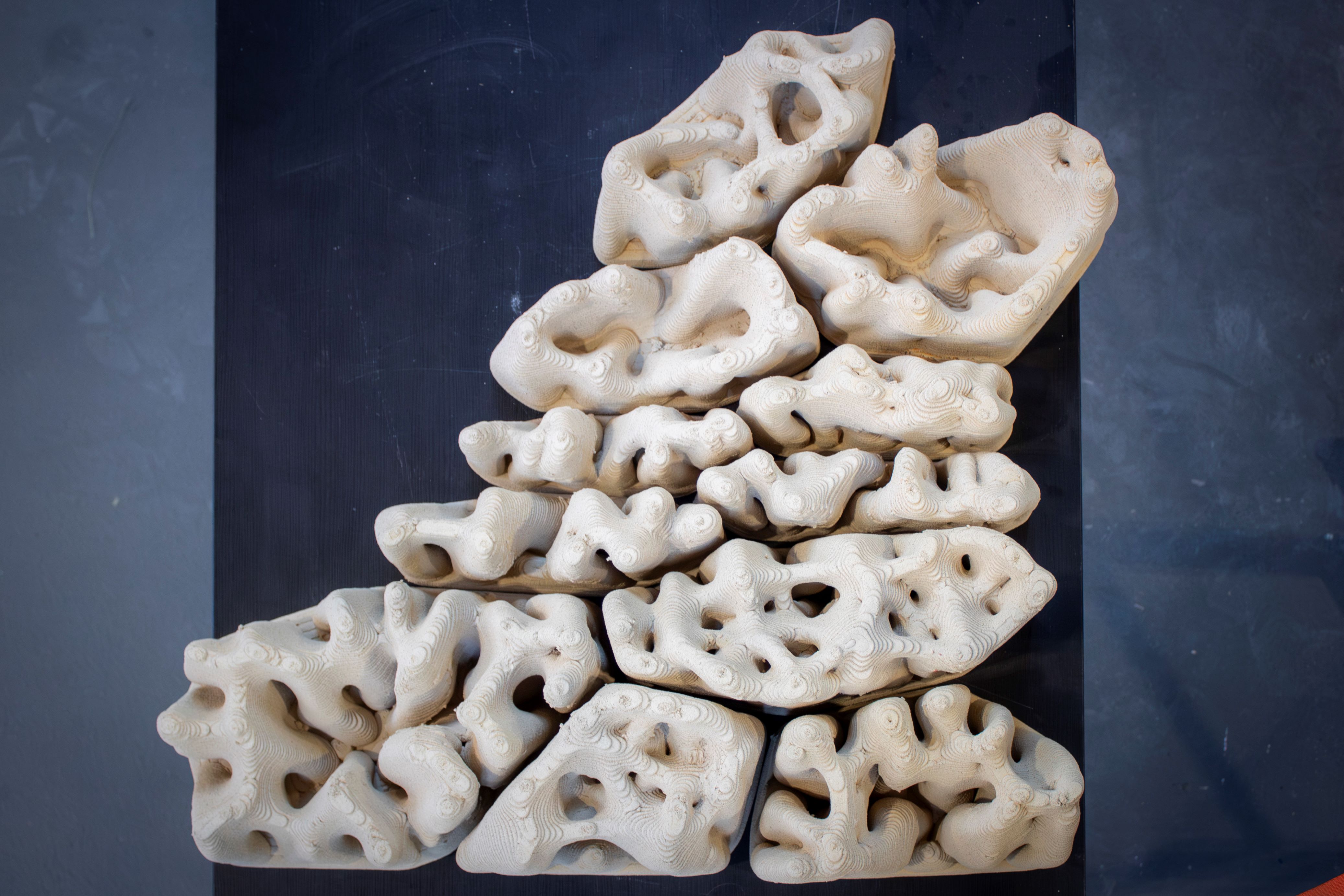
The Wall Reef exemplifies how facades can be transformed into an autonomous natural system, collecting and buffering rainwater, effectively mitigating heat stress, and creating diverse habitats without additional human intervention.
Context
The urban environment has historically evolved in response to socio-economic challenges such as affordable housing, mobility (often oversimplified as car ownership), and urban hygiene, driven by technological advancements like mass production. Consequently, urban ecology has played only a minor role in these developments. However, as our understanding evolves, the importance of healthy urban ecosystems is increasingly recognized. Additionally, new technologies now enable more natural design strategies within the built environment. But how can these innovations help create a more harmonious, nature-integrated urban landscape?
Design
The Wall Reef leverages the underutilized potential of facades. Its components feature intricate geometries, creating varied conditions and microclimates that enhance ecological potential. Each element is designed using algorithms that simulate natural morphogenetic processes, creating diverse habitats, refugia, and conditions shaped by variations in light, shade, rain, and wind exposure.
Certain components are hollow and connected to a downspout, passively channeling rainwater through cascading internal overflows and gradually distributing it through the porous material. This allows the water to evaporate, effectively yet passively cooling and humidifying the surrounding environment.
The Wall Reef exemplifies how facades can be transformed into an autonomous natural system, collecting and buffering rainwater, effectively mitigating heat stress, and creating diverse habitats without additional human intervention.