Who is safety built for?
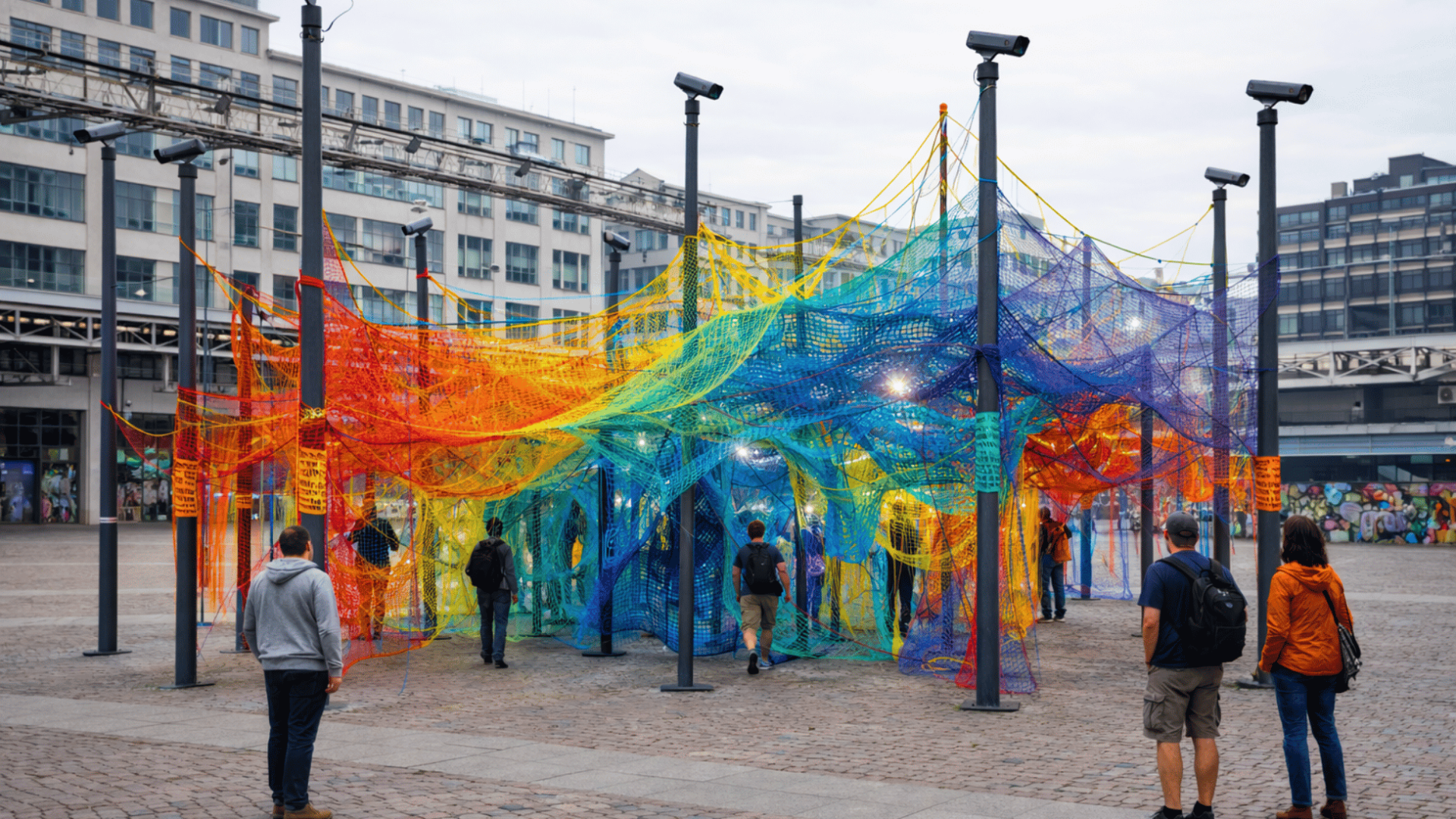
Public space is designed; so are the systems meant to make it safe. Cameras, barriers, concrete, steel and protective netting all carry ideas about who is protected and who is watched. They make safety tangible: something that can be built, installed and maintained.
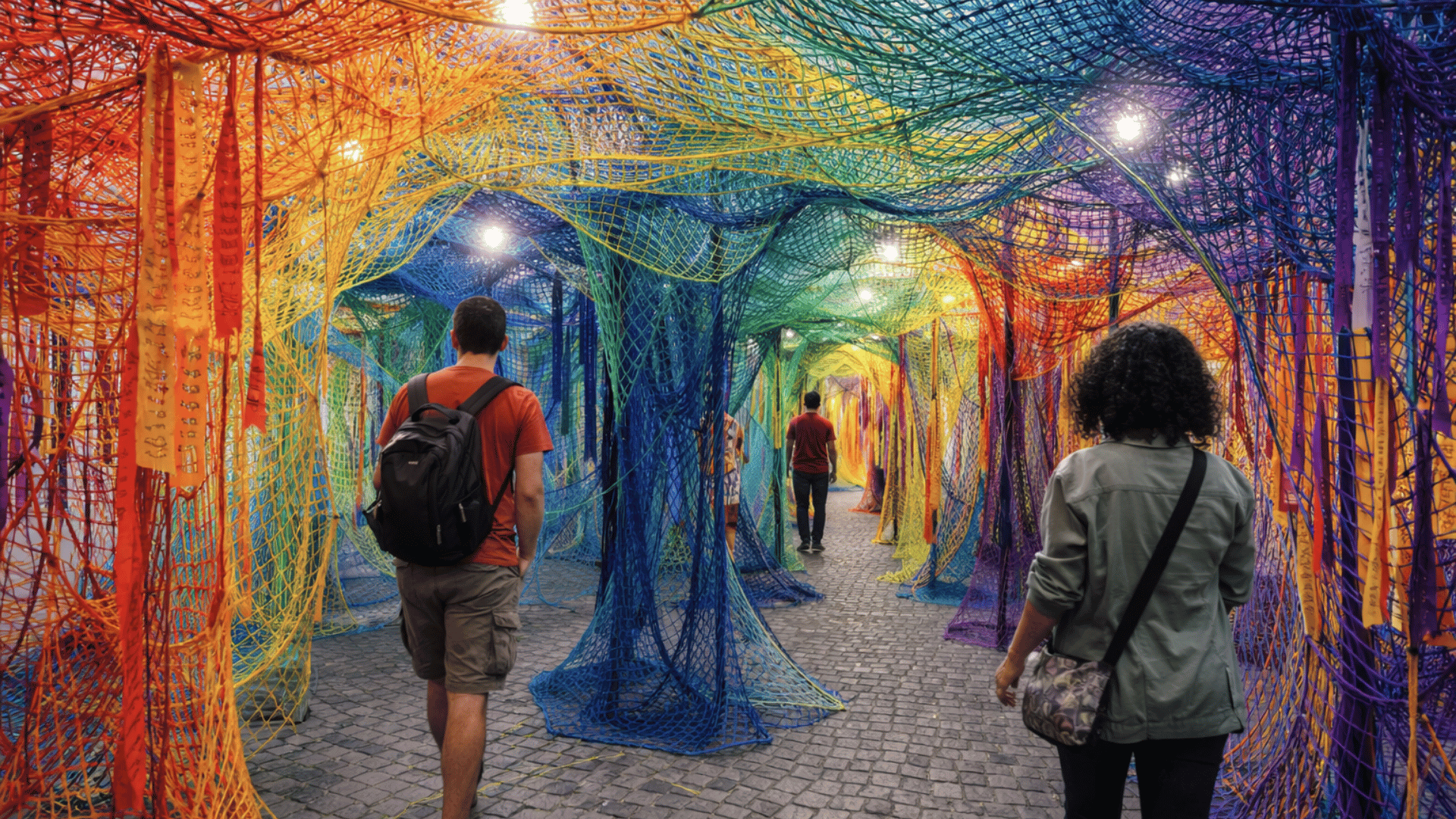
Blind Spots borrows that language. Poles, concrete ballast, steel cables, oversized CCTV cameras and brightly coloured scaffolding nets form a structure somewhere between protection, surveillance and control. The nets overlap, pass through one another and cut sightlines.
But these materials do not mean the same thing to everyone. A camera reassures one person and makes another feel exposed. A barrier protects and excludes at once. Concrete steadies; netting catches. By holding those meanings in one structure, Blind Spots asks who safety is designed for, whose experience is treated as the standard, and what is lost when a complex reality is reduced to a single narrative.
A city with many truths
There is no single experience of safety. Gender, ethnicity, disability, sexuality, class and documentation status intersect, shaping how each person moves through public space. Two people can stand on the same street and not be in the same place at all.
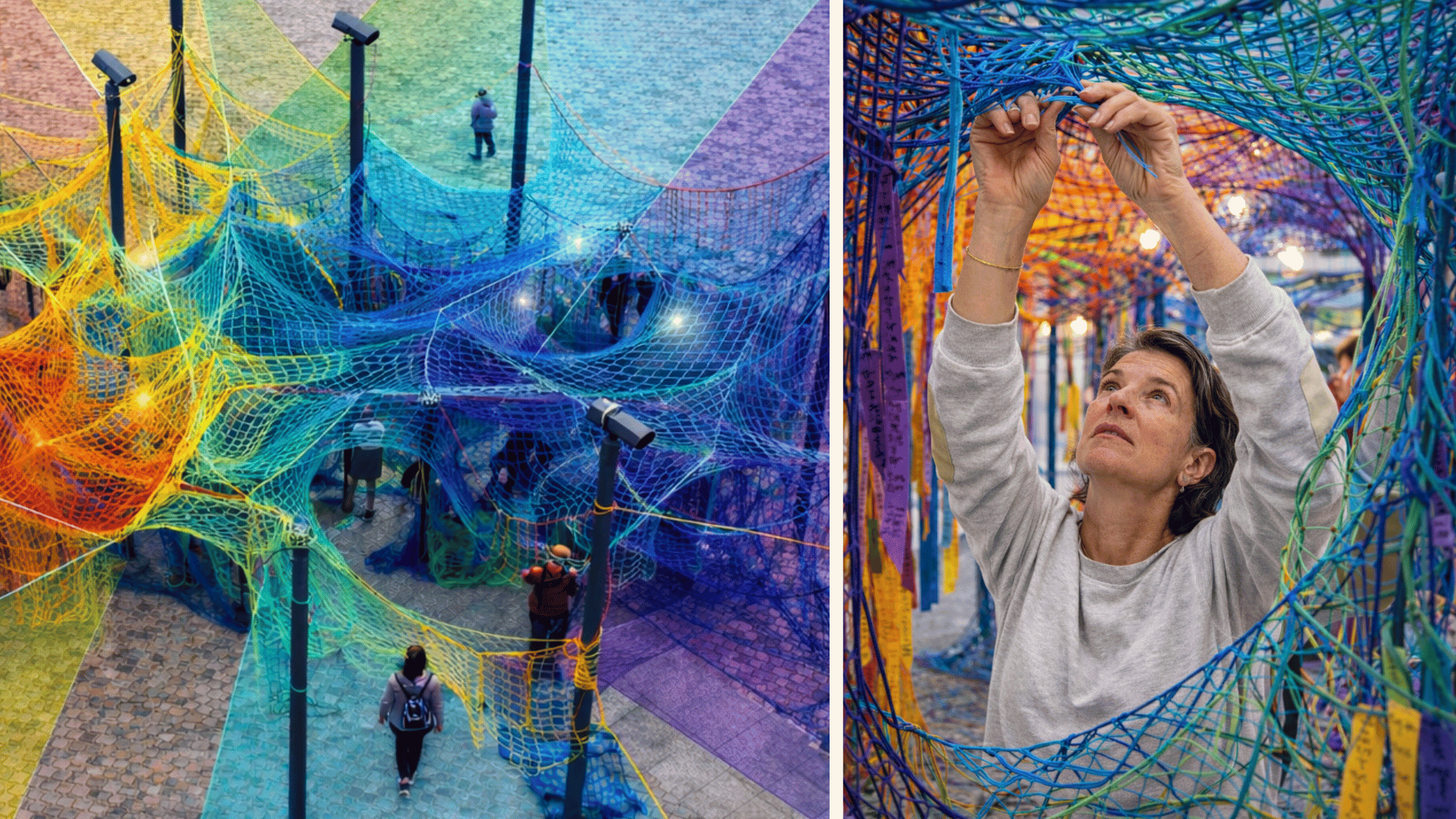
Blind Spots makes this spatial. The nets pass through and layer over one another, changing what can be experienced as you move; colours deepen where they overlap and open up again where they separate. Recorded testimonies emerge from different points in the structure: some close and clear, others distant, partial or overlapping.
The installation makes you experience intersectionality not as a concept to understand, but as a position you can never fully occupy. There is no viewpoint from which everything can be seen or heard at once. You can move towards another perspective without ever fully inhabiting it.
The places where sightlines disappear become literal blind spots: where existing systems of safety fail to see, and where another kind of infrastructure becomes necessary.
Care as infrastructure
Blind Spots changes over the course of Dutch Design Week. At the poles, visitors respond to prompts on fabric strips: What would you need to feel held here? When did a stranger make you feel safe? They write, then tie their strips onto the nets. Over nine days, the contributions accumulate. What starts as cameras, steel, concrete and netting grows denser, softer and more human: an archive made by the people passing through.
That growing layer is the care infrastructure the work proposes. It is not built by watching people from above, but through listening, recognition and response. Care here is not atmosphere or goodwill. It is something that can be designed, built and maintained, like anything else a city installs.
After DDW, the responses feed into the People’s Blueprint for Care Infrastructure: a policy advisory document co-authored by those who contributed, carrying their experiences into conversations with municipalities, ministries and other decision-makers. Cities already plan, fund and maintain systems that watch and secure public space. Blind Spots asks: what if care were treated with the same commitment?