The exhibition
By a Woman explores "worlding"—the act of imagining, shaping, and manifesting worlds—through the embodied, intuitive, and speculative practices of women artists. At its core lies a belief in feminist storytelling as a tool for re-envisioning knowledge, ecology, and power.
Why a woman? Why foreground gender at all? Perhaps the woman in the title is the maker of the work, the narrator of the story, or a shapeshifter moving between identities of each iteration. She is someone whose ways of knowing have historically been overlooked, dismissed, or excluded.
The exhibition takes these questions as an invitation to reconsider who gets to imagine worlds, whose knowledge is recognized, and how stories shape the realities we inhabit. The project approaches "woman" as an open, relational, and politically situated category, in solidarity with trans, non-binary, and gender-fluid people, and attentive to the ways identities are lived, negotiated, and continually becoming.
Worlding
By a Woman, begins from the understanding that worlds are continually shaped through relationships between people, materials, stories, and more-than-human life. The exhibition approaches artistic practice as a form of worlding: a material, imaginative, and collaborative process through which different realities can be rehearsed, inhabited, and brought into being. Feminist perspectives offer ways of attending to forms of knowledge that are embodied, situated, and relational.
About the artists
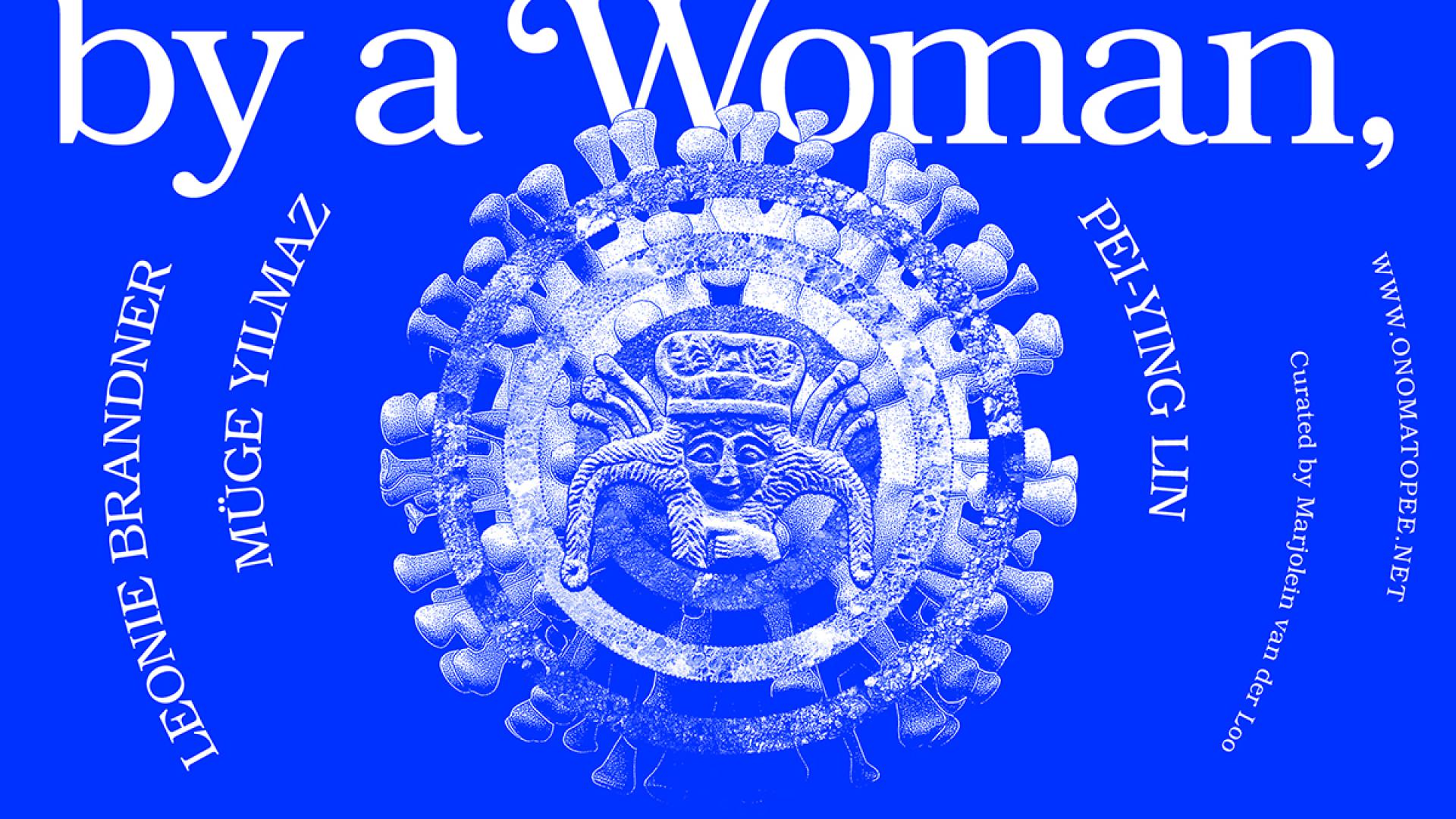
Across installation, sculptures, text, and textiles, three distinct yet deeply entangled practices unfold. Pei-Ying Lin works across microbiology, bio-art, and textile practice to explore interspecies coexistence. Her hand-knitted coronavirus reimagines an invisible organism at the human scale, transforming scientific visualization into an encounter that questions how fear, intimacy, and knowledge participate in worlding our relationships with the microbial world.
Leonie Brandner uses inherited linens, embroidery, stone, and language as living archives. Through careful acts of stitching and collecting, she connects family histories with deep geological time, showing how worlds are continuously woven through materials and memory.
Müge Yılmaz reimagines forgotten and imagined figures whose stories traverse history and the future. Her brightly coloured wooden sculptures propose feminist genealogies in which writing, science, and care become enduring technologies of world-making.