The Oldest Answer to the Newest Question
As algorithms, automation and artificial intelligence increasingly shape our world, an opposing desire seems to grow alongside them: the desire to make, touch and create something real.
CLAI explores this paradox through one of humanity’s oldest materials: clay.
Ceramic Vessels
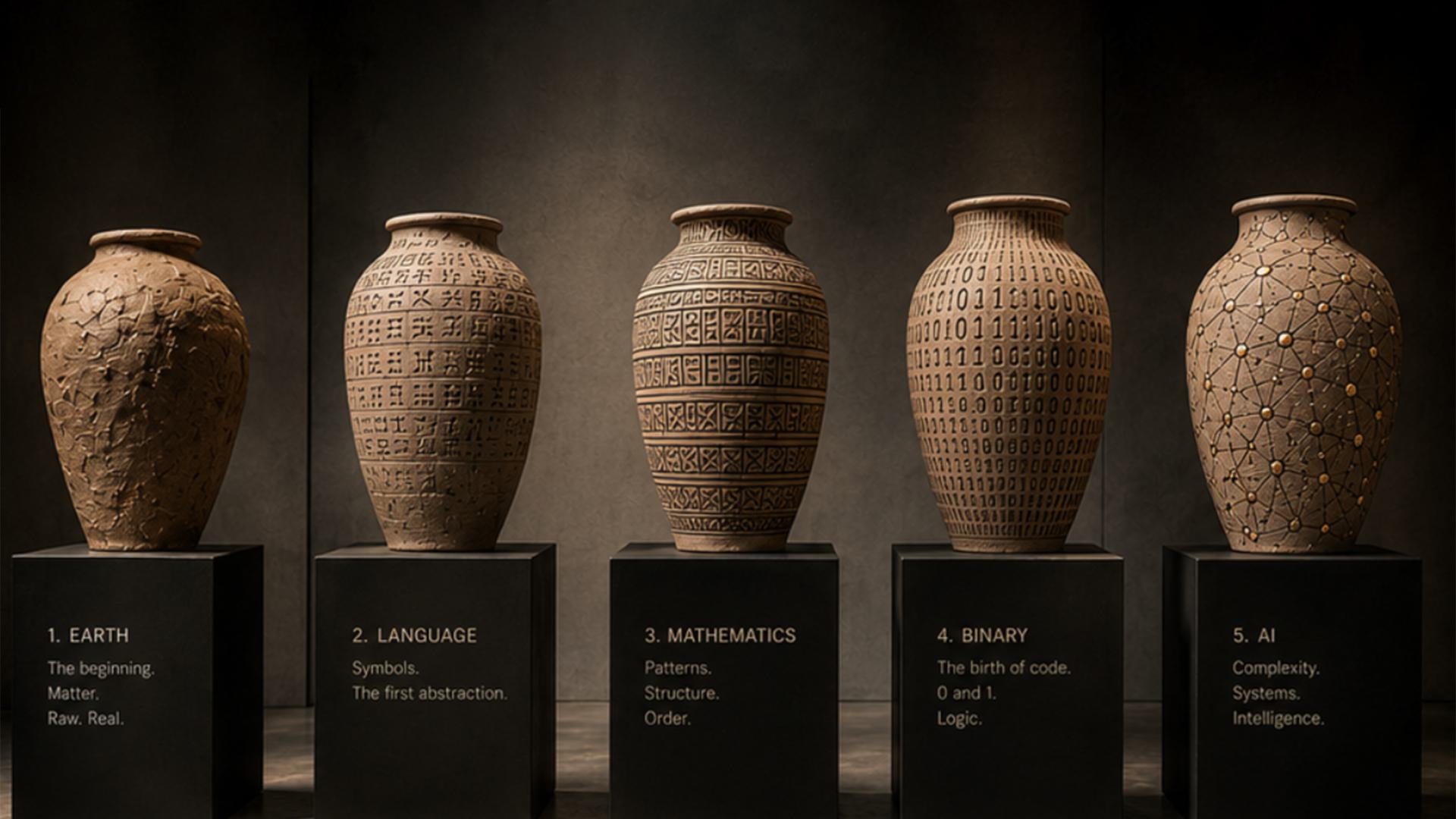
At the centre of CLAI are five monumental ceramic vessels. Each built from precisely the same archetypal form: the vessel, one of the oldest objects in human history. Their surfaces trace the evolution of human intelligence through Earth, Language, Mathematics, Binary and AI. The vessel - historically used to hold and preserve what we value - becomes a metaphor for knowledge itself.
In addition to the five monumental vases, there is a CLAI Collection.
The CLAI Collection extends the installation through a series of unique handmade ceramic objects derived from the network pattern of the fifth, AI, vessel.
Each object is individually shaped, carved and finished by hand by Charlotte van den Brand.
Visitors can purchase one of these pieces and take it home: a tangible fragment of a story about an increasingly elusive world.
Between Two Worlds
CLAI grew from Charlotte van den Brand’s own surroundings. As a graduate of Design Academy Eindhoven, she works every day with clay, one of humanity’s oldest materials, while sharing her life with a software developer working in an entirely digital medium.
Two seemingly opposite worlds exist side by side: code and clay, automation and craftsmanship, artificial intelligence and human touch.
That contrast led to the central question behind CLAI: why, as technology becomes more intelligent, do we seem to feel an ever-stronger need to work with our hands?
CLAI is presented inside NOMO Ceramics Atelier at Plan B in Eindhoven. For the Dutch Design Week, a part of the studio is transformed into a quiet, museum-like exhibition space.
After experiencing the installation, visitors can also view the adjacent 160 m² ceramics studio where the objects were created.
The studio immerses you in the physical world behind the finished work: clay, tools, kilns, and traces of the making process. Together, the exhibition and the studio tell a single story - a reminder that making remains something fundamentally human, even in an increasingly digital world.