17-25 October 2026

Living_in_the_Dome

Discover the world of dome buildings, where sustainability, beauty and serenity come together.

Hosted by Living_in_the _Dome

This project is now archived and was part of DDW23
Barbara Wojtkowska
Domes have been a part of human history since ancient times. They occur in all cultures and in all times, usually built from local, natural materials. In recent years they have been gaining popularity thanks to their elegant geometric shapes and their specific qualities.
The Dome project

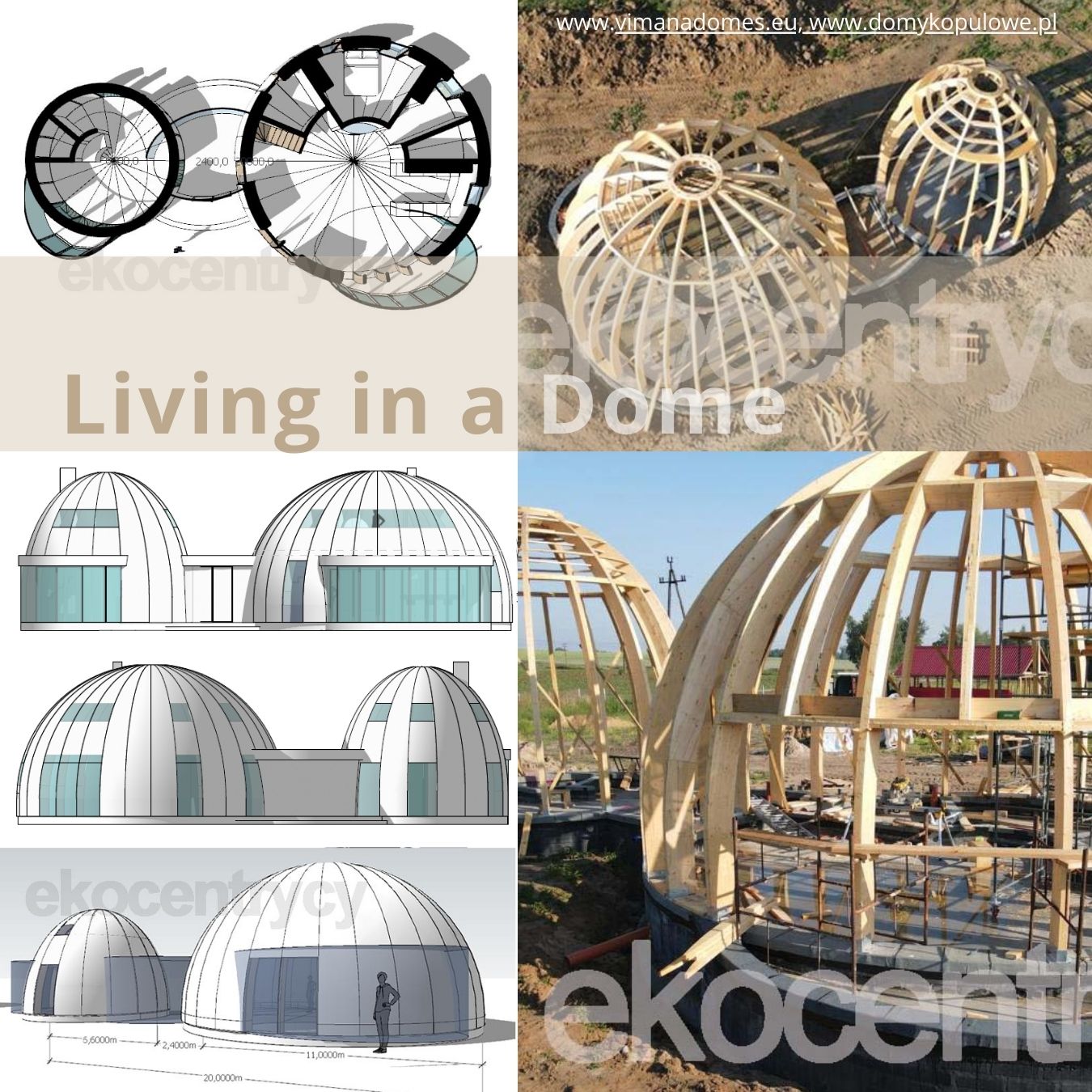
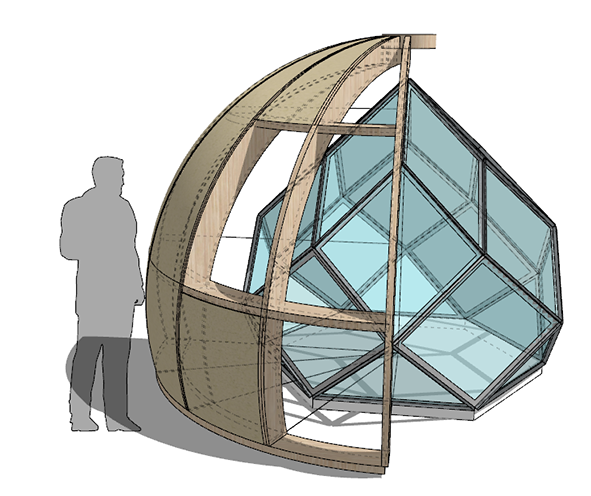
A combination of the organic form of Domes, build with natural biobased materials, has gained popularity in Poland in recent years. The architectural office Ekocentrycy has been involved in dome construction since 2018. We combine lightweight timber structures with hempcrete insulation and are currently working on several family homes, vacation cottages, and hotels in circular shapes. A stay in a Dome provides a remarkable experience of inner peace and connection with the surroundings. Users may also experience gentle chills. This project aims to investigate the effects of these structures on people's well-being and health. The structural efficiency and stability of Domes make them suitable for various climate conditions, including extreme weather. They are often associated with sustainability and environmental friendliness due to their form, which encourages efficient use of materials. Additionally, they require less energy for heating. A special case of fractal forms is the Zome shape, which has a strong impact on people. The construction idea is based on repeatable spiral modules, and we present a Zome shape 2,5 m high, covered with biobased panels.

About Domes and fractal forms

Every natural object in the universe has to obey the rule of the golden mean ratio. From the cells of our bodies, to the spiral galaxies of the univeserse all is based on this basic proportion. During the ages this knowledge was used practically in the construction process of singular buidings, dwellings or entire cities.  Plans of Prague, Cracov or Den Bosch, based on complicated and precise geometrical patterns are an obvious proof of knowlegde we don't even fully uderstand. Modern science became aware of it's meaning for the first time in 70-ties in XX century, when Polish-French mathematician Mandelbrot described principles of fractal geometry in his work. We are facing now a revolution in many fields of science and technology. Strange enough in modern architecture  reintroduction of  Fractal  Geometry principles is going very slowly. Meanwhile it can be applied in the building industry in many ways to enhance the quality of a living space, and might eventually become a new and practical tool for sustainable development. Dome buildings, and especially Zome structures, thanks to their spiral form of construction allow you to experience the fractal effect live.
Onze presentatie op DDW_zome en dome modellen
Dana Kononova, Barbara Wojtkowska

About Living_in_the _Dome

I'm a Polish-Dutch architect and designer dedicated to creating healthy homes and researching the impact of the built environment on well-being. My expertise spans building biology, feng shui, and fractal geometry. I operate from Ekocentrycy Holistic Architecture in Poland, specializing in natural material-based house design. In 2013, I pioneered Hempcrete construction in Poland. My mission: designing harmonious, aesthetic, and functional living spaces that promote health.

Colofon

Owner; Architect - ontwerper Barbara Wojtkowska - Guicherit
Medewerker / architect Dana Kononova

Partners

Sponsored by Living_in_the_Dome