A World beyond Advertisement
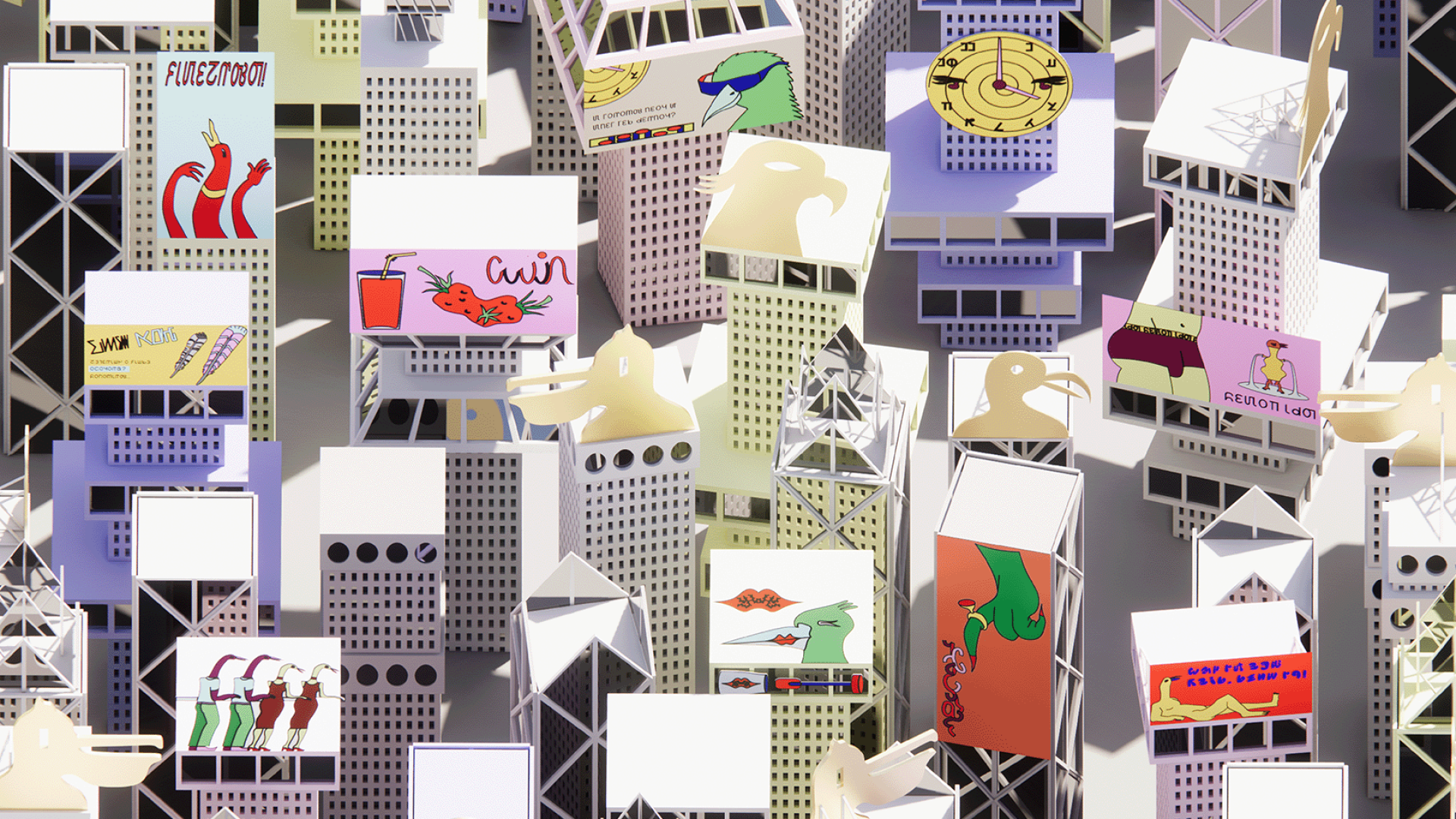
BIRREAN BILLBOARD CITY brings together a selection of billboards from the heyday of Birrea: a hyper-commercialised avian society eventually brought to collapse beneath the weight of its environmental and economic excesses.
Once enlisted in the work of persuasion, the billboards were perched atop the old Birrean cityscape. Recovered after societal collapse, they have been preserved under Princess Picquetta’s mission at the Ministry of Culture and elevated from instruments of advertisements to quasi-sacred objects of aesthetic value.
Their strange images and inscriptions, rendered in the bizarre language of Birrean, offer glimpses into a society unfamiliar yet still recognisable, inviting us to read their peculiarities back onto our own world.
The Peacock Princess’s Project
Billboards once surrounded Birrean inhabitants with images of what was desirable, beautiful, and worth becoming. Generations hatched and grew up beneath them. Princess Picquetta’s regime has learned to look at these images differently, preserving and repurposing them as signs of a shared cultural past, and in doing so turning the visual language of commerce into a language of legitimacy. Perhaps there is little difference between being surrounded by things you are told to desire and being surrounded by things you are told to admire.
Living in the Advertisement
Advertising does not simply sell us products; it sells us images of what is desirable, beautiful, and worth becoming. Increasingly, those images become part of how we present ourselves, blurring the line between being persuaded by an image and choosing to embody it. Social media has made this boundary even more porous, where advertising, personal expression, politics, and cultural allegiance can all take on the same visual language.
BIRREAN BILLBOARD CITY imagines a future in which these images have outlived the world that produced them, surviving as strange remnants whose original purpose has been largely forgotten. Removed from the streets and their commercial context, they are collected, displayed, and interpreted as cultural artefacts, offering a tongue-in-cheek parody of the ways cultural institutions turn remnants of the past into objects of cultural legitimacy. The installation explores the loss of public advertising and the ways museums give what has disappeared from public life a new cultural life, entangling preservation with the construction of ideology.